Reinsurance underpins the global economy, and Re founder Karn Saroya explains why putting it onchain is not just logical, but inevitable:
- Re is bringing reinsurance onchain backing 35 insurers and supporting hundreds of thousands of policies across the U.S.
- Re Protocol sits around $400M TVL, with reUSD nearing $100M in supply, and approx. $330M premium written since inception.
- Returns come from real world insurance premiums, with products like reUSD designed to be overcollateralized and risk remote.

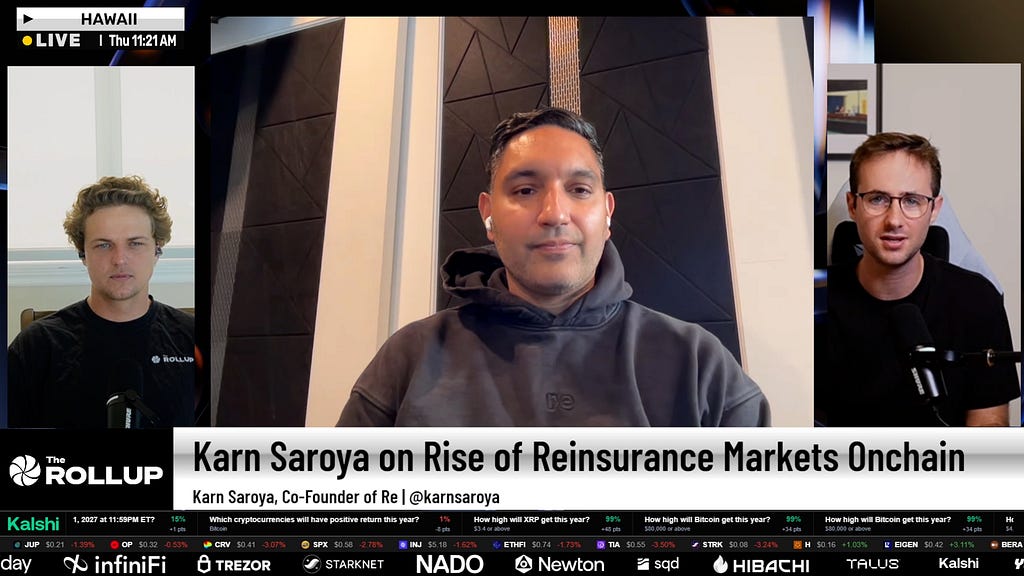
Re founder Karn Saroya joined The Rollup to unpack what it actually means to bring reinsurance onchain. The conversation spanned everything from the structure of global insurance markets to DeFi native capital, regulatory alignment, protocol design, and Re’s rapid growth over the past year. What emerged was a clear articulation that Re is building the internet capital markets for insurance.
Reinsurance is one of the least visible yet most important layers of the global financial system. While consumers interact with insurance directly through health, home, and auto policies, those insurers themselves rely on reinsurance to manage risk. Reinsurers act as the safety net for insurers, absorbing losses from events like hurricanes, floods, and wildfires. This hidden layer is what allows insurance markets to function at scale.
Re’s core insight is that this entire system, at its foundation, is about two things: contracts and capital. Insurance is a promise to pay under specific circumstances. Reinsurance is the same promise, one layer deeper. Historically, these promises have been enforced through legal frameworks, and credit ratings. Re is rebuilding that structure onchain, where capital can be transparently pledged, risk can be programmatically defined, and solvency can be verifiable.
From first principles, this makes insurance and reinsurance uniquely suited for blockchain infrastructure. When capital and obligations live onchain, the system becomes more transparent and globally accessible. The product itself does not change, what changes is the plumbing.
Over the past year, this vision has begun to materialize at a meaningful scale. “We probably run the most scalable, durable business in crypto, and it’s just starting to show. We’re talking about a trillion in premium to be accessed in the reinsurance market,” said Karn.
Re now backs 35 insurance companies across the U.S., underwriting real world risk and supporting hundreds of thousands of policies. The protocol has reached roughly $400 million in total value locked, with reUSD approaching $100 million in circulating supply. Since inception, Re has written approximately $330 million in premium. The team is targeting $1 billion in premium by 2027.
These numbers matter not just because they are large, but because they showcase something more important: Re is no longer a proof of concept. “Re has proven that we can sell reinsurance to insurance companies, and that we can connect DeFi capital to those insurance companies and make regulators happy along the way,” said Karn. It is operating at real world scale, serving real insurers, and absorbing real risk.
As Karn put it during the interview, “this is no longer a toy”. What differentiates Re from many DeFi native yield mechanisms is the source of its returns. Re is tapping into external, non-crypto-native cash flows. Millions of people pay insurance premiums every day, regardless of market cycles. Those premiums fund claims, expenses, and margins. Re simply provides a more efficient way to collateralize and distribute that risk.
This structural distinction is what makes the model durable. Insurance is not a trend, it is a permanent feature of modern economies. As Re scales, its cost of capital declines, its operating leverage increases, and its ability to underwrite more diverse risk expands. Scale is not just a growth metric, it is a functional advantage.
Risk architecture is another place where Re’s design diverges from traditional systems. The protocol is intentionally structured so that Re itself absorbs junior risk, while depositors sit in a senior position. Products like reUSD are designed to be overcollateralized and risk remote, giving users exposure to insurance linked yield without bearing the full underwriting risk. This layered approach allows participants to choose their proximity to the core insurance exposure.
Importantly, Re is building a protocol, not just a company. The long term vision is a marketplace where multiple reinsurers and insurers can directly access onchain capital. In this model, Re is not the rate limiter. The bottleneck becomes onboarding new insurers, structuring new lines of business, and expanding the breadth of risk available to capital providers.
This is what Karn referred to as building the internet capital markets for insurance. The founder story behind Re is central to its credibility. Karn previously built and scaled an insurance company from scratch, navigating underwriting, pricing, servicing, and regulatory frameworks. That experience exposed the inefficiencies and capital constraints of the traditional reinsurance stack. At the same time, he observed the rise of DeFi protocols capable of coordinating tens of billions of dollars in capital. This capital had a better economic use case than most of what it was being deployed into.
Re exists at the intersection of those two worlds. It required technical innovation, regulatory navigation, broker relationships, and structural experimentation. That work is now paying off, as Re becomes a trusted counterparty for both traditional insurance players and onchain capital.
Regulatory alignment has been a critical part of this process. Rather than fighting existing frameworks, Re is building within them. With stablecoins becoming normalized and regulatory clarity improving, insurers are treating onchain capital as a legitimate, auditable source of collateral. Re has often been the first trading partner to bridge this gap, helping insurers understand how blockchain based capital can coexist with traditional compliance regimes.
Looking ahead, Re is entering its next phase. The protocol’s points program is maturing, integrations are expanding, and conversations with funds and institutional partners are accelerating.
The point is simple: this is not another DeFi yield product, but a reinsurance infrastructure showing up onchain in measurable ways. The traction is already visible: $400M TVL, 35 backed insurers, $100M reUSD supply, and $300M in premium written, with a $1B premium target by 2027.
That progress does not happen by accident. It reflects a disciplined execution from the team. If the longer term vision is internet capital markets for insurance, then the current growth is proof-of-work.